Environment & Energy
Related: About this forumUN weather agency warns of record 'climate imbalance' as planetary warming accelerates
https://news.un.org/en/story/2026/03/1167178All-time high greenhouse gas concentrations in Earth’s atmosphere continue to drive heat records on land and sea, with long-lasting consequences for humanity, the World Meteorological Organization (WMO) warned on Monday.
…
“Between 2015 and 2025, we experienced the hottest 11 years on record,” WMO’s deputy executive secretary Ko Barrett said.
…
Grim state of climate
Presenting a grim overview of the state of the climate in 2025, Ms. Barrett stressed that as glaciers continue to retreat and ice continues to melt, “the warming ocean and melting land-based ice are driving the long-term rise in global mean sea level rise.”
…
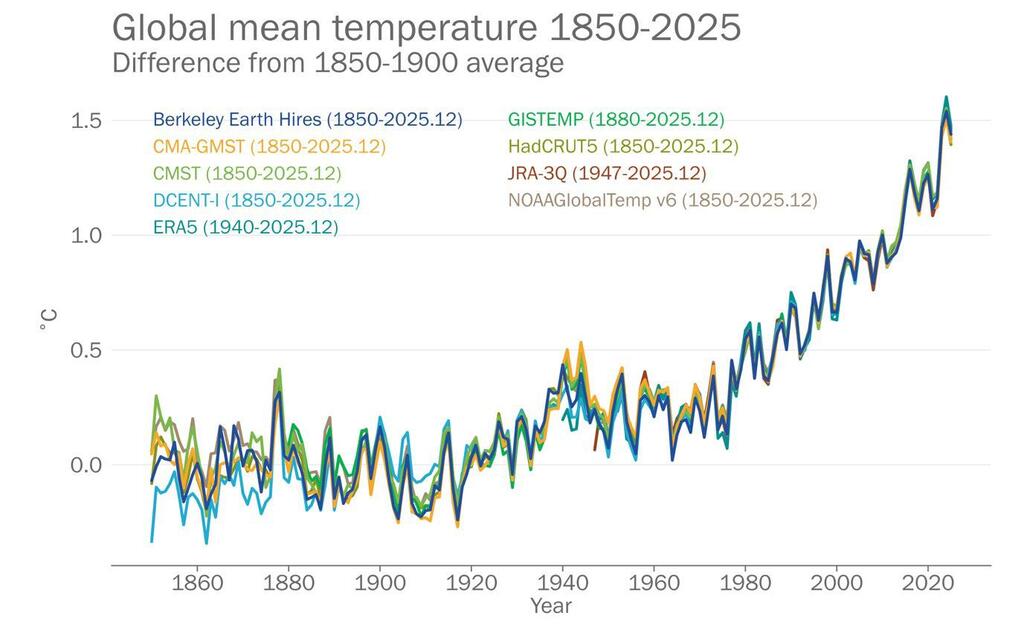
…
Record greenhouse gas levels
The agency’s scientific officer John Kennedy said that concentrations in the atmosphere of three key greenhouse gases (carbon dioxide, methane and nitrous oxide) reached record levels in 2024, the last year for which there are consolidated global numbers.
…
Worrying energy imbalance
…
“The largest fraction of that absorbed energy is going to the oceans, around 90 per cent of the excess energy in the climate system,” Mr. Kennedy said. “This matters because over three billion people depend on these marine and coastal resources for their livelihoods. They’re living off the ocean, and nearly 11 per cent of the global population live on low-lying coasts directly exposed to coastal hazards.”
https://wmo.int/publication-series/state-of-global-climate/state-of-global-climate-2025
https://doi.org/10.59327/WMO/S/CRI/SOC1
 = new reply since forum marked as read
Highlight:
NoneDon't highlight anything
5 newestHighlight 5 most recent replies
= new reply since forum marked as read
Highlight:
NoneDon't highlight anything
5 newestHighlight 5 most recent replies

IbogaProject
(5,868 posts)it takes almost 200 times the energy to get ice from 0 to 1 centegrade so that is where that energy is going. Think about how long it takes for a couple bags of ice to melt in a cooler. That is happening on a planetary scale. And to be extra frightful there is a chance this global heating could go runaway if the methane hydrates in the polar regions start releasing in mass. There was a major extinction event 4 or 500 million years ago where 95% of life was wiped out due to a massive methane release. Our planet hasen't warmed this quickly ever before there isn't time for plants to gradually relocate as the climate bands move. Here is a good resource to realize how screwed we all are, this guy has been forcasting climate collapes for the range of 2026-30 for at least 10 to 15 years that I've been following him. The fact we are now 1.5 C up means that methane tipping point can hit the artic very soon. The Pacific and Western USA are experiencing record heat currently. https://arctic-news.blogspot.com/

OKIsItJustMe
(21,845 posts)…
A planet Earth in a fragile equilibrium
With their new climate models, the scientists have calculated that a very small increase of the solar irradiation – leading to an increase of the global Earth temperature, of only a few tens of degrees – would be enough to trigger this irreversible runaway process on Earth and make our planet as inhospitable as Venus. One of the current climate goals is to limit global warming on Earth, induced by greenhouse gases, to only 1.5 degrees by 2050. One of the questions of Guillaume Chaverot’s research grant is to determine if greenhouse gases can trigger the runaway process as a slight increase of the Sun luminosity might do. If so, the next question will be to determine if the treshold temperatures are the same for both processes.
…
When that study was published, I thought, “If we have warming of 'a few tens of degrees' we’re all toast anyway."
https://www.columbia.edu/~jeh1/mailings/2026/Runaway_Climate.2026.03.06.pdf
Runaway climate change can occur, if climate feedbacks are large enough. Global warming caused by 2×CO₂ or a 2% increase of solar irradiance would be only 1.2°C, if there were no climate feedbacks, because 1.2°C warming increases radiation to space enough to restore planetary energy balance. However, observations and modeling reveal three main feedbacks increased atmospheric water vapor, decreased cloud albedo (reflectivity), and decreased sea ice albedo – and all are amplifying. The net feedback effect is described by a simple equation, 6 ΔT = 1.2°C/(1 – g), where ΔT is climate sensitivity for 2×CO₂ and g is the feedback “gain” in our feedback parlance. ⁹ Climate system gain today (sum of all feedbacks) is likely between g = 0.7 (thus ΔT = 4°C) and g = 0.75 (ΔT = 4.8°C), as we will show in later chapters.
Runaway climate occurs if g approaches unity. Runaway happened several times when the Sun was weaker, Earth was cooler, and sea ice was extensive. Atmospheric CO₂ varies due to the level of volcanic emissions and other processes associated with movement of continental plates. When decline of CO₂ caused enough cooling for sea ice to expand toward the tropics, g reached unity and runaway to snowball Earth occurred. ¹⁰ Eventually, volcanoes increased atmospheric CO₂ enough for sea ice near the equator to melt, and runaway global warming ensued. Warming then was likely rapid until the “fuel” for the sea ice feedback (sea ice area) was small enough for total gain, g, to subside to less than unity. Since the most recent snowball event, 600 million years ago, the Sun’s irradiance has increased 6%, making another snowball Earth implausible.
…
The “runaway” climate threat now is the danger that today’s accelerated global warming will push Earth past a “point of no return,” with irreversible consequences for today’s young people and their descendants. I described the danger of rapid ice sheet collapse and sea level rise as the “tipping point” in a December 2005 tribute to Charles David Keeling ¹⁴ and Bill McKibben popularized this a month later in an article ¹⁵ in the New York Review. However, Lenton et al.¹⁶ now use “tipping point” for a broad range of climate feedbacks, many of which are reversible when the climate forcing is removed or replaced with global cooling. Therefore, I prefer “point of no return” ¹ as terminology for the point of lock-in of unavoidable ice sheet collapse.
The danger of passing the point of no return is taboo with the United Nations Intergovernmental Panel on Climate Change (IPCC), the organization that we should expect to be most protective of the future of young people. This reticence of IPCC is a cause for concern, which deserves to be pointed out and vigorously debated. IPCC relies on models with millennial response times, even when driven by forcings that dwarf any experienced in Earth’s history. Based on paleoclimate data, global modeling, and ongoing ocean and ice sheet observations, we have concluded that shutdown of the ocean’s overturning circulation could occur within decades and this will affect ocean/ice sheet interactions and the rate of sea level rise. ¹⁷ We will show in later chapters that up-to-date data support these conclusions. Concern about the danger of passing the point of no return is not a reason to panic. The climate system’s delayed response provides time to take preventive actions, if the science is understood well enough to define effective policy actions.
…