Environment & Energy
Related: About this forumA Coal Combustion "Legacy:" Widespread Contamination of North Carolina Aquatic Ecosystems.
The paper to which I'll refer in this post is this one: Legacy of Coal Combustion: Widespread Contamination of Lake Sediments and Implications for Chronic Risks to Aquatic Ecosystems Zhen Wang, Ellen A. Cowan, Keith C. Seramur, Gary S. Dwyer, Jessie C. Wilson, Randall Karcher, Stefanie Brachfeld, and Avner Vengosh Environmental Science & Technology 2022 56 (20), 14723-14733.
Here's the nice little teaser cartoon from the paper:
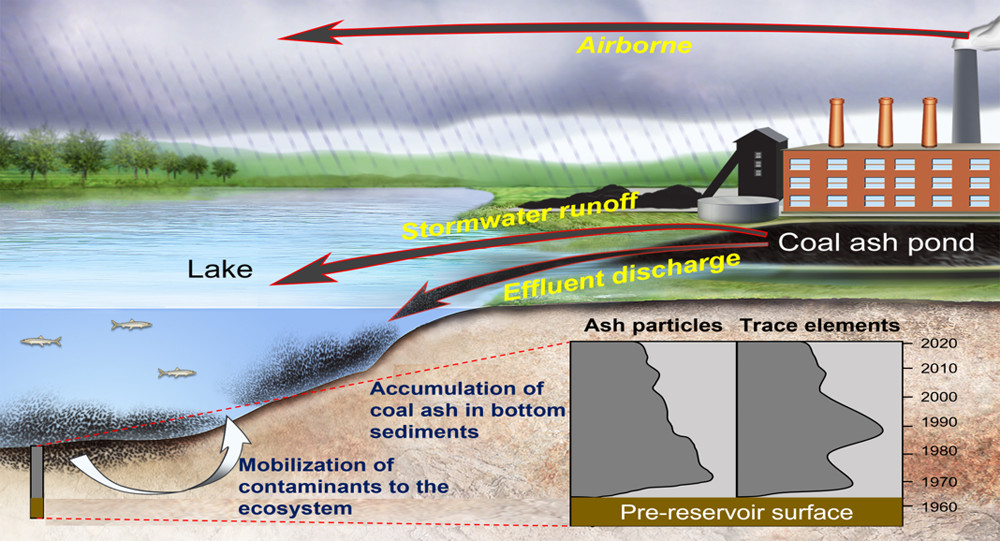
Let's jump right in to some excerpts from the text. From the introduction:
Serious public concerns? You don't say? To what may we compare these putative "serious public concerns?"
The introduction continues:
As, arsenic, you don't say? Tl, thallium, the most common use of which is as rat poison, you don't say?
We have a "coal ash rule?" What does it do?
Well, the authors want to find out. They hope to address the "limited...understanding of coal ash contamination in aquatic ecosystems."
Really? Isn't it true that what we don't know won't hurt us? Do we really want to know? Do we have to know?
The authors say yes, we should know, and so they set out to study coal waste in North Carolina lakes. The lakes are described:
This sounds like a good idea in the case of Mountain Island Lake, using a coal cooling reservoir as a source of drinking water.
A map:
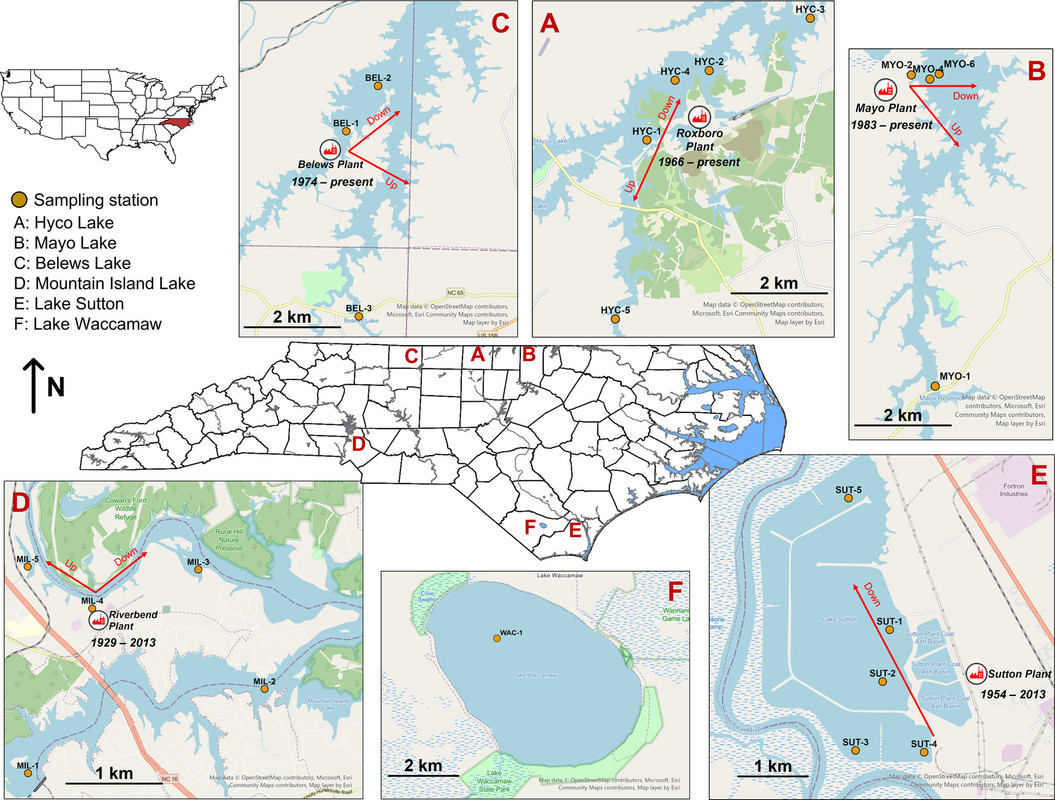
The caption:
A description of outside of this paper can be found at the website of the Catawba River Blue Way:
Mountain Island Lake was built in 1924 with the construction of Mountain Island Hydroelectric Station. The lake has approximately 3,281 acres of surface area and 61 miles of shoreline. The lake also supports Riverbend Steam Station by cooling the steam that drives the turbines and provides a dependable water supply for Mount Holly, Gastonia and Charlotte-Mecklenburg, North Carolina.
The bold is mine. Note that the primary energy source of the steam is not mentioned. This is rather like people who've been carrying on about hydrogen for five or six decades while the world was catching fire; neither steam nor hydrogen are primary sources of energy. Both have been widely produced by the combustion of coal.
The sediments in Hyco lake show three phases corresponding to changes in regulations, measured by age of the sediments, which are obviously stratified by time, with the dating being confirmed by measurement of cesium-137 (the Cs137/Ba137 ratio) from nuclear weapons testing in the 1950s and 1960s. The overall quantity of particles in them can be measured by magnetic susceptibility, corresponding to the presence of magnetic phases. This is shown in the following graphic for one of the lakes, Hyco lake, where preimpoundment levels of coal ash were close to zero.
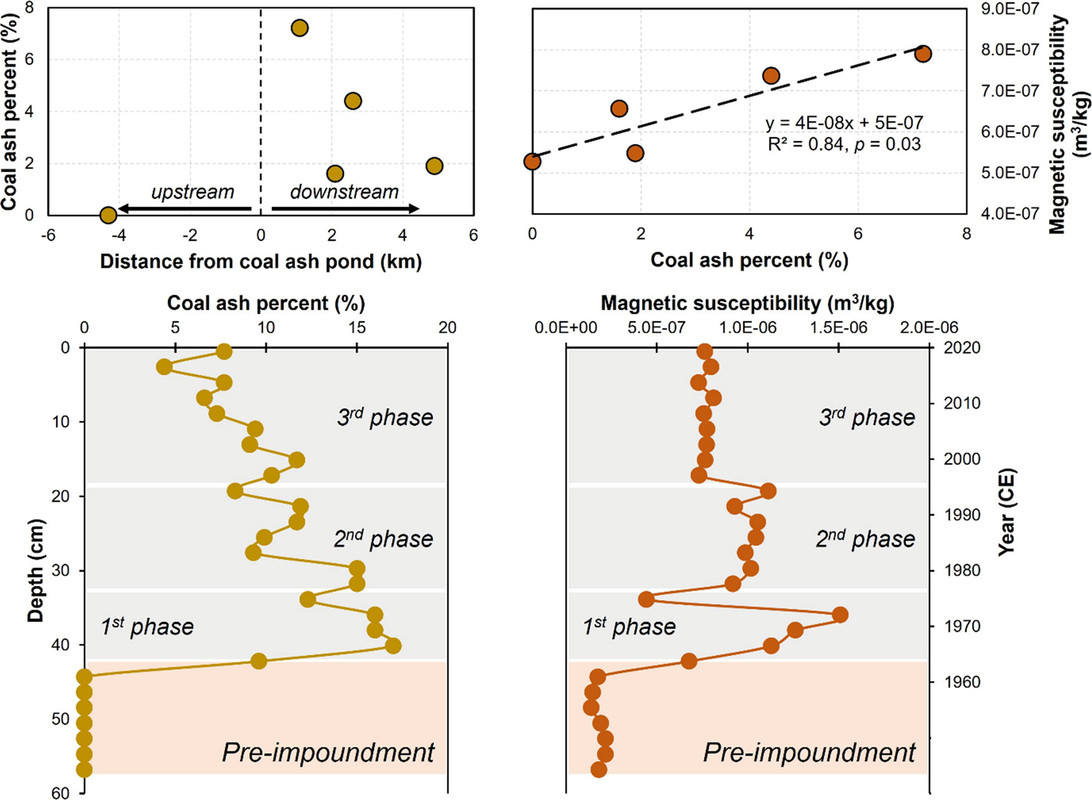
The caption:
In terms of the percentage of coal ash in sediments, shown in the figure above only for Hyco Lake, overall the percentage of coal ash in sediments in all of the lakes ranged from 0.7% to 17% according to the text.
The phases for Hyco Lake are described thus:
The third phase corresponds to a period where rather than being stored in wet impoundment ponds, the coal ash was being trucked away to dry landfills.
Lovely.
Some of the elements associated with the coal ash in the lakes.
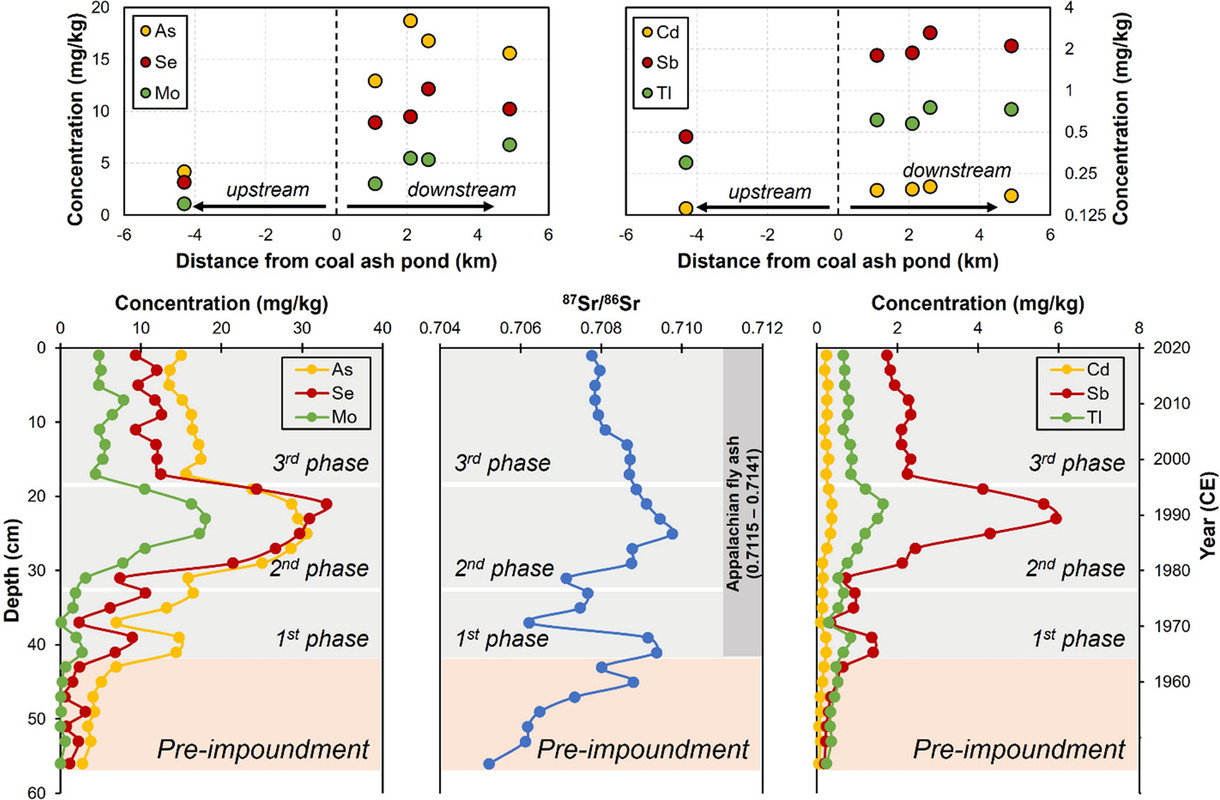
The caption:
As (arsenic), Se (selenium), Cd (cadmium), Sb (antimony) and Tl (thallium) are all toxic elements. Mo (molybdenum) is not, and it plays a key role in natural nitrogen fixation by plants. Selenium is actually an essential trace element in living systems, although it is toxic beyond a threshold. The Sr87/Sr88 ratios are determinants in changes of source. Sr87 is the decay product of Rb87, the radioactive isotope found in all natural rubidium, rubidium as a congener of potassium which it mimics physiologically, being the second largest source of natural radioactivity in living cells, after potassium-40. (Rb87/Sr87 is often used to date extremely old geological systems, ranging from hundreds of millions of years to billions of years.)
The rate of disposition compared to measured water flow rates:
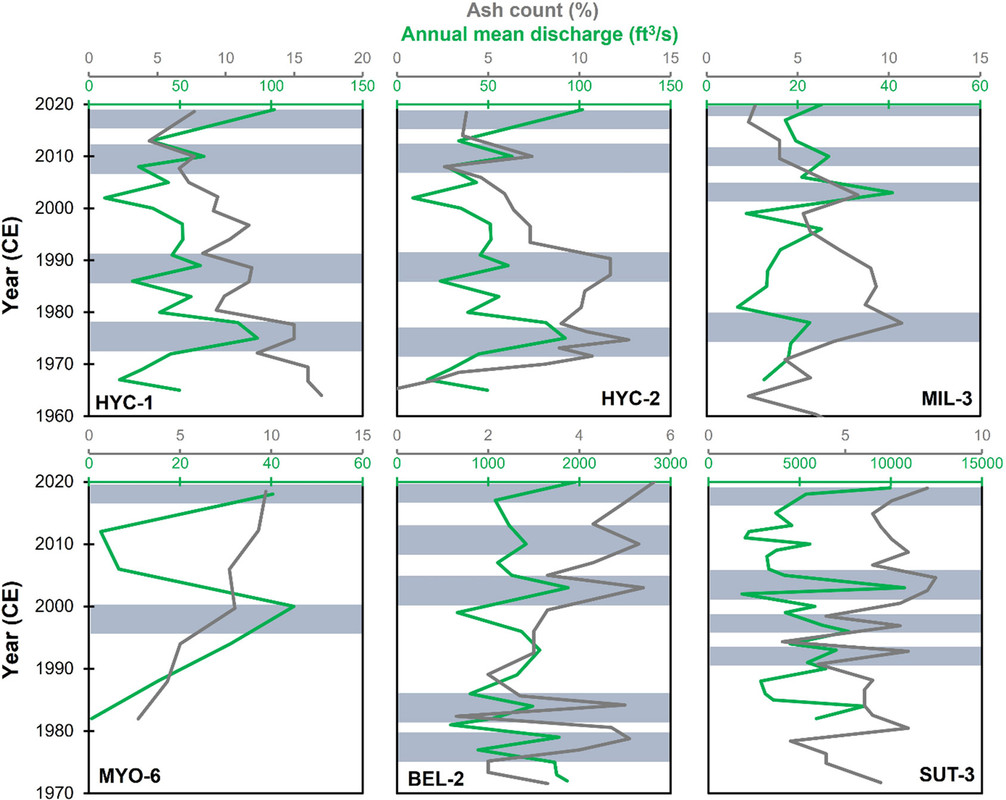
The caption:
And now, the important issue, the issue of risk. No form of energy is risk free, because among other things, it's energy. The difference in the overall risk to humanity and to the environment is a question related to the distribution of contaminants, and, because of the fundamental rule of toxicology, "the dose makes the poison." This is true certainly of the element selenium mentioned above, selenomethionine is often an ingredient of nutritional supplements, but high doses of selenium can cause severe health problems, even death. One question seldom addressed is whether material side products can be contained. Personally I don't think that dumping waste into lakes, artificial or otherwise is "containment" nor is dumping it in the atmosphere, the seas, or, at the end of the day in landfills. Note that all of the above applies to carbon dioxide, perhaps in the long run the most dangerous of all fossil fuel wastes.
As for the lakes, a heat map shows risks associated with different periods of coal waste releases derived from sedimentation patterns:
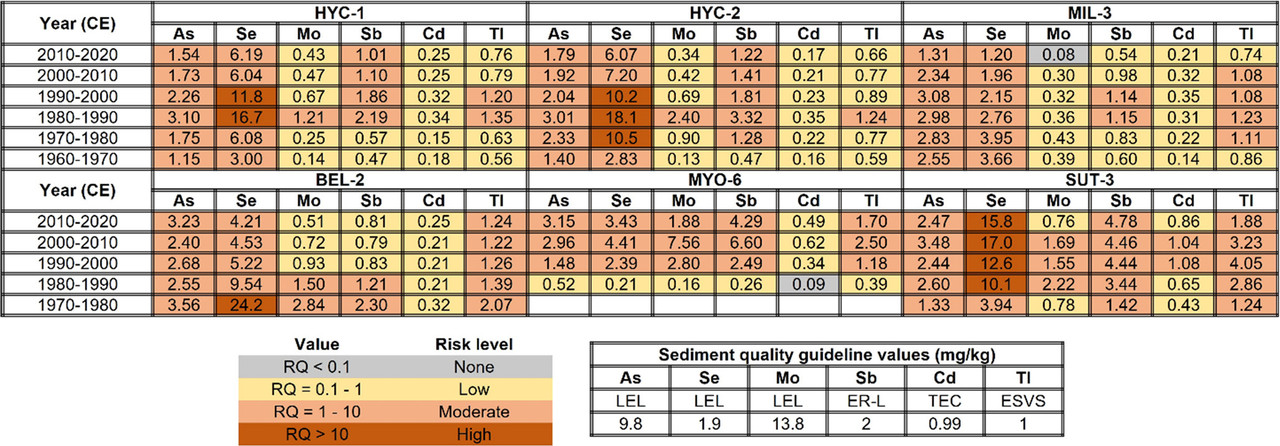
The caption:
I hear a lot about so called "nuclear waste," often from overtly dishonest people of a certain class that has appeared in recent years here and elsewhere, the "I'm not an antinuke" anti-nukes, people who wish to assume that I'm a MAGAT class moron, inasmuch as I can't see through an obvious self-misrepresentation that is clearly Trumpian in scale. If you drag out every racist trope and then declare you're not a racist, you're still a racist and in addition, a liar. If one drags out every anti-nuke trope and then declare you're not an anti-nuke, you're an anti-nuke, thus also a liar.
Period.
In response to these types, prattling on stupidly about so called "nuclear waste", I often cite the most recent iteration of Lancet series of papers recording risk factors for human disease and mortality to note that between six and seven million people die each and every year from air pollution - which I call even if the media doesn't - "dangerous fossil fuel waste," (although some of these deaths actually result from "renewable" biomass combustion).
This open sourced document is here: Global burden of 87 risk factors in 204 countries and territories, 1990–2019: a systematic analysis for the Global Burden of Disease Study 2019 (Lancet Volume 396, Issue 10258, 17–23 October 2020, Pages 1223-1249,
Then, regularly and often, not that it gets through many of the heads of Trumpian thickness, I excerpt it:
The most probable annual death toll from air pollution using the figures above the above, is 6.67 million deaths per year around 18,300 per day; at the 95% confidence interval, the true number may range from a low of 5.84 million deaths per year, around 16,000 per day, to 7.57 million deaths per year, around 20,700 per day.
The commercial nuclear power industry is now almost 70 years old. If you press any and all anti-nukes to identify as many deaths over the entire 70 years from the storage of used nuclear fuel who will die as will die today, in a single day, from air pollution, they'll mutter all kinds of mindless excuses for not doing so, make dishonest attempts to change the subject to equally atrocious misrepresentations, usually involving either the three big bogeymen of the energy ignoramus, Fukushima, Chernobyl and/or (even) Three Mile Island.
The numbers of people who have died from air pollution, assuming the relative constancy of the Lancet numbers and using the most probable figure, 6.67 million deaths per year - a crude approximation that may nonetheless be supportable - since these events is for, Chernobyl in 1986, 240,000,000 human beings, for Three Mile Island, in 1979, 284,000,000 human beings, for Fukushima, in 2011, 73,000,000 human beings. In the case of Three Mile Island and Chernobyl, in the "percent talk" that anti-nukes use to misrepresent the growth of so called "renewable energy" this death toll is roughly 580%, 480% and 150% of death toll from World War II from all causes, including genocide, attacks on civilians, military actions, starvation and resource deprivation, respectively for Three Mile Island, Chernobyl and Fukushima.
Vast sums of money have been spent to "clean up" these three horsemen of the anti-nuke ignorance squad's nuclear apocalypses, without ever raising the question of whether on a risk balanced basis these putative "clean ups" includes any metric that is remotely risk based. The "standard" assumption is that Fukushima, for example, must be "cleaned up" to a standard such that no badly educated fool can even imagine a risk to anyone at any time. To get a feel for this, one should consider the hula boo raised about the release of Fukushima's tritiated water into the ocean. I would welcome a scientifically supportable - not some bullshit nonsense from a website funded by the ignorance factory at Greenpeace or its equivalent, that the risk associated with this release over eternity, will approximate the risk associated with the dumping of air pollutants in the next hour, which will be around 750 deaths.
No matter how much money is spent to "clean up" Fukushima to any standard of acceptance criteria will save very few lives, since very few lives are currently at risk. We can see this clearly by noting that people are not dying in droves from radiation leaking from Fukushima's reactors, even though the reactors have not yet been "cleaned up." This suggests that the same approach being applied to North Carolina's damaged lakes, doing nothing to "clean them up" to Fukushima standards, that no one, even with a poor education, can even imagine a risk, to the reactors would not be a catastrophe. The most serious risk associated with failed reactors everywhere, Three at Fukushima, one at Chernobyl and one at Three Mile Island is probably the radionuclide mentioned above for aging the sediments, weapons testing derived Cs-137. (Everyone born after 1950 has lived their entire lives with exposure to this nuclide.). The half life of Cs-137 is 30.08 years. This means 62% of the Cs-137 present at the time of the Three Mile Island reactor accident has decayed, correspondingly 54% and 22% for Chernobyl and Fukushima respectively. Perhaps a rational approach to a reactor failure might be to immediately stabilize the situation, and come back in a century or two to recover the remaining radioactive materials. I would suggest that the diesel fumes from all the trucks used to "clean up" nuclear reactors may have killed more people than the radiation releases ever will.
Now, what would be the cost of cleaning up the five contaminated lakes in North Carolina to the same standard that is putatively being assigned to Fukushima. I'm sure no analysis has been done, because the same assholes who whine about "cleaning up" Fukushima continuously couldn't care less about dangerous fossil fuel waste. The anti-nukes who run Germany have shut their nuclear reactors to burn coal. They obviously do not value human lives over the assertion of their ignorance.
Let's just make a crude estimate of the procedure: The first step would be to completely dredge all sediments of all the lakes to a depth associated with all of the time that coal waste has been flowing into them. The next step would be transport all of the coal waste to a treatment facility. Since the processed contaminated sediments would surely measure in the millions of tons, this would involve a lot of heavy equipment to unload the sediments from the (surely diesel) powered barges, on to diesel trucks, to be transported to what would surely be a massive plant where energy will be spent to dry the sediments, to leach them with - let me guess, nitric acid - neutralize the acid using bases prepared using combustion of dangerous fossil fuels, concentrating the toxic elements, and then placing them in a form where they can be "safely" isolated in what will be massive landfills.
Now consider that these are only five lakes, in a relatively small area of the planet, and consider that there must be thousands upon thousands of similar situations all over the world.
Some idiot wants to tell me about putative cost of the "clean up" of Fukushima?
Really?
Can anyone really be that obtuse? Apparently so. Apparently there are a lot of people this obtuse, which does not bode well for the future of humanity.
Note that Fukushima, Chernobyl, and Three Mile Island were all reactor failures. The situation with coal waste, and indeed the far worse problem of climate change, which no amount of money can "clean up" without major conversion to all energy sources to nuclear energy, result from the normal operations of dangerous fossil fuel devices, powerplants and transportation, not system failures.
History will not forgive us, nor should it.
I trust you will have a pleasant Sunday.
 = new reply since forum marked as read
Highlight:
NoneDon't highlight anything
5 newestHighlight 5 most recent replies
= new reply since forum marked as read
Highlight:
NoneDon't highlight anything
5 newestHighlight 5 most recent replies
Kookoo
Kookoo


enough
(13,760 posts)appalling, even stunning.
Tacking on a screed about the stupidity of people concerned about nuclear waste is counterproductive. No one wants to begin a thought process, or take in new information, while being aggressively insulted.

ms liberty
(11,237 posts)
NNadir
(38,054 posts)The planet is on fire, people died from extreme heat in streets all over the world this summer, major crops failed, ancient giant river systems dried up, glaciers which serve as the water supplies for billions of people disappeared.
If someone's feelings are hurt because I make comparisons about risk, I really, really, really couldn't care less.
I have serious opinions. I spend my time in the primary scientific literature, not repeating rote dogma. If someone would like to make a representation that the use of nuclear energy is comparable to the above listed events in 2022 related to energy waste, I invite them to do so.
If they refuse to do so because it offends their pet dogma, again, I couldn't care less.
There is a world to save, and unless one can make comparisons, one is useless to addressing the task. If the world is saved, and it's looking less and less likely by the hour, nuclear engineers will save it. I consider this to be an ethical opinion and I don't care who it offends.
Have a nice weekend.

hunter
(40,691 posts)... especially for the natural gas industry.
Solar and wind energy are not economically viable without fossil fuels for the simple reason that the sun doesn't always shine and the wind doesn't always blow. This is not a problem that can be solved with batteries, especially now that the human population is exceeding 8 billion.
The math isn't difficult. Let's say you have a nation that gets 50% of its electricity from nuclear power. If you double the number of nuclear power plants that nation will get 100% of its electricity from nuclear power.
The same is not true of wind or solar power. Let's say, generously, a nation gets 50% of its energy from solar and wind power. Doubling the number of wind turbines and solar panels will not cover 100% of the nation's demand. In general it won't even raise the percentage to 60%. Mostly what it will do is increase the number of wind turbines or solar panels that are producing electricity uselessly when there is no demand, or idled because there is not enough wind or sunshine. Installing more wind or solar capacity hits a wall of diminishing returns. The gross tonnage of batteries it would take to cover days or weeks of solar and wind outages (which are not uncommon) is ludicrous.
It's already possible to model this using actual operational data collected in California where we have gigawatts of wind power, solar power, and energy storage capacity already installed. You can subtract out natural gas and nuclear power from the mix and see how such a system might be operated without it, and what sort of economy that "renewable" energy system could support. The numbers are not pretty, and will get worse with drought since nearly all of California's electric storage capacity is hydroelectric.
Solar and wind energy are incapable of displacing fossil fuels entirely.
If we don't quit fossil fuels entirely billions of us will suffer and die from the consequences of global warming.
Unfortunately billions of us are dependent on high density energy resources for our survival. Nuclear power is the only high density energy resource capable of displacing fossil fuels entirely.
It's not good enough to cut our fossil fuel use in half; if we dump some amount of greenhouse gasses over one year or two the eventual consequences will be the same. The only thing that matters is the total amount of greenhouse gasses we dump into the atmosphere. We've already overshot any comfortable limits. Any additional fossil fuel use, in support of renewable energy schemes or not, will only make things worse.