The role of pride and shame in the human hive

Philosopher of pride: For Mandeville, humankind has a bottomless need to be liked: it is this perennial craving that forms the foundation of society
https://aeon.co/essays/the-hidden-role-of-pride-and-shame-in-the-human-hive


In 1705, the Anglo-Dutch physician and philosopher Bernard Mandeville anonymously published a poem called
The Grumbling Hive: Or, Knaves Turned Honest. He described a vast community of bees – a transparent metaphor for contemporary Britain – and the mechanisms of its wealth. In the hive, each bee works for its own personal gain, every profession has its cheat, and everyone exploits the passions of others. But the welfare of the community is not endangered:
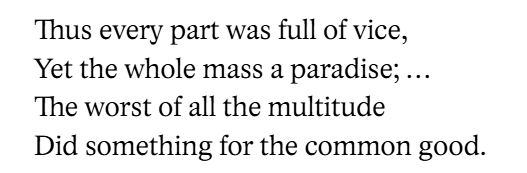
Even more scandalously, when the insects did implement moral reform and forced themselves to live according to honesty and virtue, the community fell into a downward spiral.
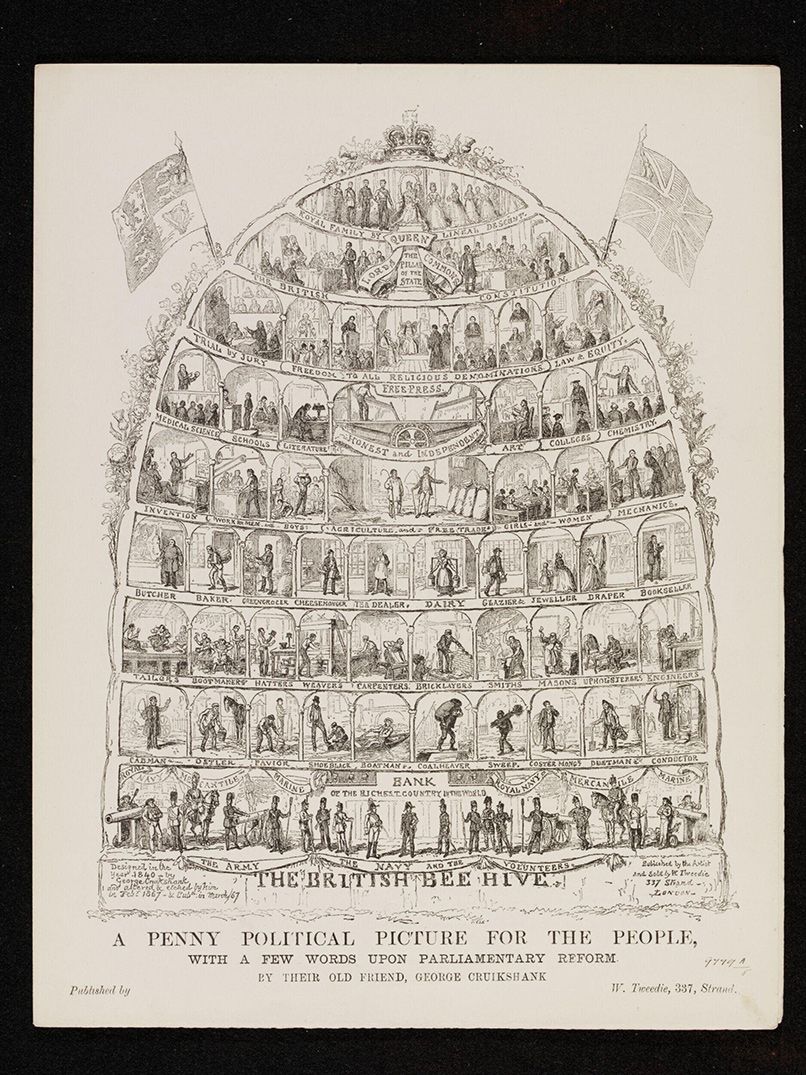 The British Bee Hive (1867) by George Cruikshank. Courtesy the British Museum
In 1714, and in an enlarged edition in 1723, Mandeville published the prose volume that made him infamous:
The Fable of the Bees: Or, Private Vices, Public Benefits. The original poem was reprinted with a series of commentary essays in which Mandeville expanded upon his provocative arguments that human beings are self-interested, governed by their passions rather than their reason, and he offered an explanation of the origin of morality based solely on human sensitivity to praise and fear of shame through a rhapsody of social vignettes. Mandeville confronted his contemporaries with the disturbing fact that passions and habits commonly denounced as vices actually generate the welfare of a society.
The idea that self-interested individuals, driven by their own desires, act independently to realise goods and institutions made
The Fable of the Bees one of the chief literary sources of the
laissez-faire doctrine. It is central to the economic concept of the market. In 1966, the free-market evangelist Friedrich von Hayek offered an enthusiastic reading of Mandeville that anointed the poet as an early theorist of the harmony of interests in a free market economy, a scheme that Hayek claimed was later expanded on by Adam Smith, reworking Mandeville’s paradox of ‘private vices, public benefits’ into the profoundly influential metaphor of the invisible hand. Today, Mandeville is standardly thought of as an economic thinker.
There is no question that Mandeville ‘discovered’ the division of labour, defended luxurious consumption and, most important of all for economic historians, expressed the view that the pursuit of individual self-interest can be beneficial to society. But the dominance of economic readings of Mandeville has overshadowed the breadth of his interests and writings, the project behind them, and in general his stature as an accomplished philosopher whose influence on the Scottish and European Enlightenment remains to be reconstructed in depth. Mandeville never made economic issues the focus of his analysis, and his arguments concerning trade, luxury and wealth form only one part of a broader examination: his psychological analysis of self-love and of the social effects of the hidden workings of pride and shame.
snip
