General Discussion
Related: Editorials & Other Articles, Issue Forums, Alliance Forums, Region ForumsPerfumed effigy of ‘Butcher’ Duke raises a stink in the Highlands
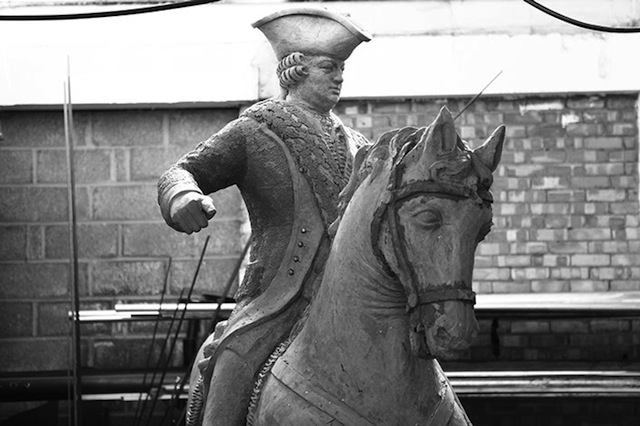
The life-size statue of Prince William Augustus on a horse is to be erected in Cavendish Square, London, later this month on the exact spot where his previous effigy – removed in the 19th century because of his ‘war crimes’ – once stood.
The statue will be made of soap, as part of a City of Sculpture art project, and will eventually melt away, but the work has provoked anger in Highland Scotland where “Butcher” Cumberland is still reviled.
South Korean artist Meekyoung Shin became intrigued by the empty Cavendish Square plinth on her frequent visits to London. She is renowned worldwide for soap sculptures that are deliberately allowed to erode to convey the temporary nature of historic events and how they are differently perceived as time passes.
According to the Haunch of Venison gallery in London, which showcases Shin’s work, the one-year-project “is supposed to bring focus to the passage of time as the sculpture weathers.
“As the sculpture erodes, the scented soap will disintegrate and release a perfumed aroma. The details of the statue will soften and fade over time, symbolising the mutable meanings we attach to public monuments and, in a wider sense, to all aspects of history.”
The Duke – the younger son of King George II – put down the Jacobite uprising at the Battle of Culloden on the 16 April, 1746. However, it was the barbarity of his orders that have echoed down through history. The Duke insisted that no quarter be given to the wounded and, after the battle, his men spent hours scouring the battlefield bayoneting to death any wounded rebels.
Paul Scott, the president of the Saltire Society, said: “I think this is terrible idea. He was the ‘Butcher of Culloden’ who not only massacred wounded men on the field of battle but tracked down and killed many Jacobites in the days and weeks after Culloden. As far as I know he had few redeeming features and is certainly not deserving of a statue. The plinth should be left empty.”
Roderick Balfour, an independent councillor for Culloden said: “I know the people round here would regard it as an affront, even though it is a soap statue and might wash away pretty quickly. This is not the kind of thing that will improve relations between the Highlands and England.”
Read the whole article here: http://www.scotsman.com/scotland-on-sunday/scotland/perfumed-effigy-of-butcher-duke-raises-a-stink-in-the-highlands-1-2399182
A effigy of 'Stinking Billy' the ‘Butcher’ she doesn't understand his actions will never wash away.
 = new reply since forum marked as read
Highlight:
NoneDon't highlight anything
5 newestHighlight 5 most recent replies
= new reply since forum marked as read
Highlight:
NoneDon't highlight anything
5 newestHighlight 5 most recent replies
HiPointDem
(20,729 posts)Response to HiPointDem (Reply #1)
bupkus This message was self-deleted by its author.
MichaelMcGuire
(1,684 posts)To many the negative actions of him has had long lasting effect. After all this was a time (1740-46) where Westminster was discussing plans to sterilise the women in the Highlands. People like him thought so little of 'these' Scots in a similar way they think of the Irish.

It comes as no surprise that the racial superiority they had was also adapted and easily used to justify African enslavement and the genocide of American tribes.
"Red-coated British soldiers scavenged the Highlands in its aftermath, burning villages, raping women, killing all the 'vermin', 'banditti' and 'scum' suspected of being rebels even those who had fought on the government side. One English officer wrote to Cumberland that several hundred homes were "burned already... [but] still so many more houses to burn" (11). Another reported that his troops had, "carriedfire and destruction as they passed, shooting the vagrant Highlanders that they met in the mountains and driving off their cattle".(12) The black cattle, the basis of the Highland economy, were driven to Fort William and sold onto Yorkshire traders in order to starve the people and devoid them of any means of support."
Back to the OP
She says:
"The fact that the Duke was such a politically controversial figure brings an unexpected and interesting dimension to the work and brings to light the issues I wanted to explore through this project."
Ignorance on 'the subject' of her art isn't a interesting dimension.
(11) James Hunter, Last of the Free, (1999) p.19
(12) James Hunter, The Other Side of Sorrow, (1995), p29-30

hedgehog
(36,286 posts)compressed dung maybe?
Response to MichaelMcGuire (Original post)
bupkus This message was self-deleted by its author.

muriel_volestrangler
(106,201 posts)and more German than either. Son of George II, his ancestors were German, with the occasional Dane, until you get back to James VI; you have to go back to James's great-grandmother to get an English ancestor (Margaret, daughter of Henry VII). And it's infamous that there were more Scottish soldiers in his army at Culloden than in the Young Pretender's.