General Discussion
Related: Editorials & Other Articles, Issue Forums, Alliance Forums, Region ForumsBill Clinton and Republicans promised NAFTA would create jobs..
the exact polar opposite resulted.
NAFTA began to erase the American factory.
Then Bill Clinton granted Most Favorable Nation trade status to China.
Enter the 'election' of Bush.
As part of Bush's 2001 tax cut, massive tax incentives are created for corporation to offshore jobs to China and thus 'create' jobs in China. They were given major tax break incentives to close factories in America and outsource jobs to China under the guise of job creation and receive a major tax cut for 'creating' jobs.
Bush promised expansion of free trade would create jobs.
Further erasing the American factory.
Further eroding the American worker and all that we had fought to gain as a workforce.
American workers saw good wages and benefits erased in the name of corporate greed and Mussolini-style Fascist pro-corporate, anti-worker, anti-wage, pro-exploitation that grew in Italy in the late 1920's and forward.
We are the new Fascist Italy of the late 1920's and forward.
Corporatism is today's Mussolini Fascism.
Free Trade, for-profit banking, the MIC, police states are how it's being carried out.
Free Trade is tearing the Democratic Party apart because it destroys the very ideals that made our party great, at one time, in the past.
We've been promised that Free trade would create jobs in the past with NAFTA, again with Bush's expansion of FT and now Obama's promise that TPP will also create jobs.
TPP will kill jobs like NAFTA killed jobs. The same way Bush's tax incentive to offshore jobs, killed American factory jobs. Killed the support jobs that supplied factories with materials and parts. A domino effect. Closing factories brought back decay and in worst cases, ghost towns.
Free trade made the housing bubble go POP!
Which almost sunk our nation.
Enter the Great Recession. A depression that we are still mired in.
Caused 100% by free trade.
That's why I say..
Free Trade is tearing the Democratic Party apart.
 = new reply since forum marked as read
Highlight:
NoneDon't highlight anything
5 newestHighlight 5 most recent replies
= new reply since forum marked as read
Highlight:
NoneDon't highlight anything
5 newestHighlight 5 most recent replies
Armstead
(47,803 posts)You summed it up succinctly and, in my opinion, accurately.
I would disagree somewhat with a couple of point, however.
Banks are inherently for-profit institutions, and there's nothing inherently wrong with that. The problem is the extremely greedy degree to which they have focused on that to the exclusion of their social role. And the other problem is the horrific growth of a few mega banks, and the disappearance of more accountable community banks.
I'm not sure free trade is tearing the Democratic party apart, because there's too little awareness and too much apathy about it. But it is certainly weakening it, sucking the enthusiasm of many and diluting the party's ability to have any principals.

Cicada
(4,533 posts)Clinton promised jobs, and he delivered.
Armstead
(47,803 posts)
pampango
(24,692 posts)Keeping it out of the WTO? That probably would not have helped. Russian exports to the US and the rest of the world were not slowed down by it not belonging to the WTO.
Armstead
(47,803 posts)Yes, I said it. Nothing wrong with some protective tariffs and rules to avoid the debacle that has happened since then.
Alas, I can't go into more details or big discussion right now--work calls and preparing for the big storm.
But in general, I remember the debate at the time. And looking at results, it is one more sign that the whole "free trade" policies of the last 15 years have done more harm than good.
pampango
(24,692 posts)Too late. Damn that Clinton! Somehow we let Cuba into the WTO in 1995. Where's the outrage over that? (I was all ready to tell Cuba, "No deals for you. We may have kept you poor, but now it is time for you to "bootstrap" yourselves out of poverty. Now I can't do that.)
I guess a modified "US only" embargo (high tariffs serve as a barrier to trade as does an embargo) is better than trying to enforce a global embargo on China as we have done with Cuba. But then how would we have kept China from exporting its goods to Canada, Mexico or Europe and ending up with them getting into the US that way. Do we need protectionism against all those countries, too? Maybe we can build more of those walls that republicans seem to want on the Mexican border all around the country. If it weren't for foreigners we would be just fine.

brentspeak
(18,290 posts)You mean the kind of high tariffs that your favorite repressive ultra low-wage nation China assesses against the US? Those kinds of tariffs?
As has been asked of you many times before: stop hiding behind an FDR avatar to push your US Chamber of Commerce talking points. FDR tolerated regulated free trade between the US and highly developed nations of comparable wage scales; he didn't want to ship American industries overseas to near-slave-labor nations such as China and Mexico and then have those products shipped back to the US for sale on American store shelves.
You're not fooling anyone here.
reddread
(6,896 posts)
Agnosticsherbet
(11,619 posts)during an administration 22.5 million. Of course, he led during one of the great expansions in American History. There is no way I know of to find out what affect Nafta had on that expansion during his administration.
According to Huffington Post, a million jobs have been lost over time due to NAFTA. These were also lost at a time when the world economies were changing. Companies have automated at a record pace, become more efficient, and moved jobs to China for cheap labor. Now that China is developing a middle class, they are moving to other countries with cheap labor. It is cheaper to build whole factories when transportation of goods is dirt cheap. Would these changes have happened without NAFTA? It is quite possible that the economic changes and the changes in technology would have had the same affect. It is convenient to say, NAFTA did it. Hard to prove it directly. There are other movements contributing to the change. Certainly, the flight of manufacturing would have occurred even in NAFTA had never been passed.
Spider Jerusalem
(21,786 posts)that expansion would have happened no matter who was president. That was during the 90's tech boom when the technology sector that had been growing in the previous decades really took off, when computers went from toys for the upper middle classes to standard home appliances, when the Internet and the rise of the web created an industry and hundreds of thousands of jobs that weren't there before.
The '90's? More comparable to the 1920's than anything, economically. Maturing industries create new jobs and generate vast amounts of paper wealth that leads to overinvestment and too many competitors in a given market sector which leads to the bubble bursting and an eventual crash and consolidation. In the '20's it was radio and film and home appliances and cars. In the '90's it was the tech sector.

JDPriestly
(57,936 posts)That was the tech boom and bust. I'm not disagreeing. I am just clarifying for those who call it the dot.com bubble.
Agnosticsherbet
(11,619 posts)Because the world is in a constant state of change. Massive changes in technology and communication made it easier to off shore jobs and save money for investors and owners at the expense of workers. China did not open the floodgates of cheap labor because of NAFTA. They did so because it made sense within the context of their own society and national agenda and the explosive growth of their own modern industrialization. For the same reason, a growling middle class created by that industrialization has increased the cost of their labor and many of these cheap labor jobs are migrating to other parts of Asia and Africa. Technology makes it cheaper to build a new factory in Sri Lanka or Uganda. This process was actually at work in the 60's with the development of Maquiladoras in Mexico that led to the shipment of jobs from the US. China actually poached a lot of those jobs with the promise of even cheaper labor.
I am not fond of Free Trade agreements, but they are not the only historical current that created todays situation. NAFTA is a symptom of the proliferation of International Corporations who chase poverty so they can use the desire of starving people for any kind of work. Once those workers get a glimmer of hope, the Corporation moves on to the next country because it is better for corporate profits to find the lowest wages possible for everyone but executives, the board of directors, investors, and owners.
The real answer is not bitching about NAFTA. The real answer is a world wide labor movement. Unions need to go international for real and fight for better wages in every country because a raise of $.05 an hour here is impetus for an industry to go where they can pay a worker $.01 for every dollar a worker makes here. As long as Corporations can move to take advantage of cheap labor for a fraction of the cost of transportation, this process will continue. Free Trade agreements are only a tiny fraction of that process, and they are not the cause of it.
pampango
(24,692 posts)If manufacturing jobs had declined after decades of advance and wages had suddenly fallen, you can be sure it would have been blamed on his trade policy.
If what actually happened does not support your policy belief, blame this contradictory reality on luck or other things. (That tactic works well for republicans when they argue that raising the minimum wage will increase unemployment. It is not supported by actual experience but that does not slow them down.) If what actually happened supports your policy choice, point to it as proof that you were right all along.
Huh.
Oh, right. He delivered; I get it now.

pa28
(6,145 posts)We've learned our lesson with NAFTA yet the Washington consensus is urging us into the same mistake. Unforgivable.

Recursion
(56,582 posts)Seriously, why are we so divorced from the actual facts here?
Here is a time graph of manufacturing wages in the US. In free fall, until NAFTA:

Here's manufacturing jobs as a share of the economy vs. manufacturing output:
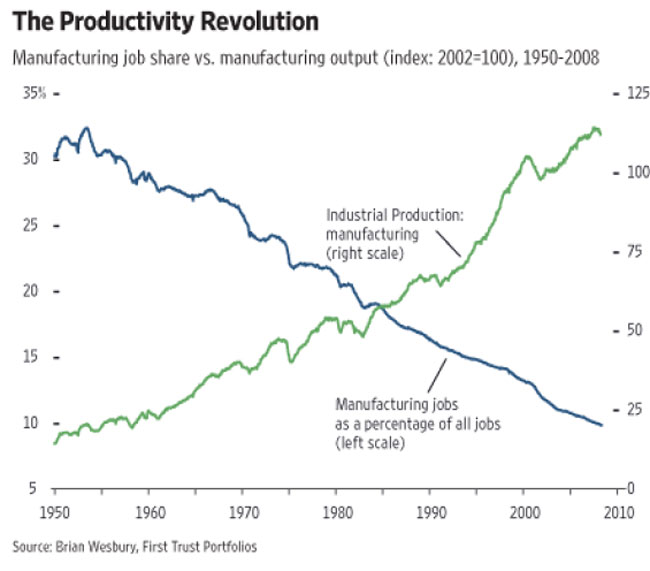
For the past 60 years, we have been manufacturing more with fewer workers. NAFTA didn't stop that, but it did mean the ones who were still working made more money. Today the US manufactures more than at any point in our history. The myth that American manufacturing has disappeared is completely bogus.
Here's US median household income. Notice that big jump after NAFTA?
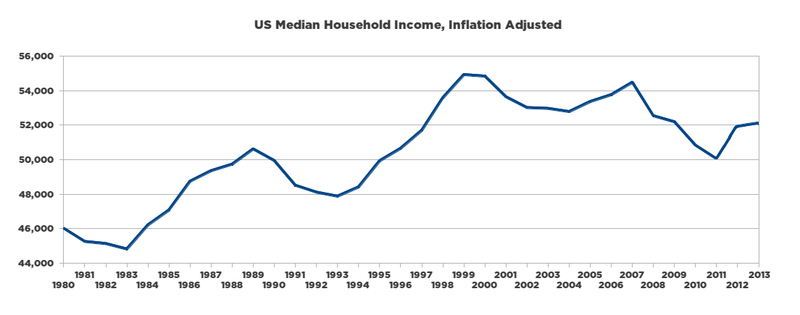
Here's the unemployment rate. Notice how it drops steadily through the 1990s, and only goes up after Bush's disastrous tax cuts?

JDPriestly
(57,936 posts)made in other countries?
If it were true that so much stuff is manufactured in the US, surely I would find the words, "Made in the USA" on more that I buy than I do.
Rarely do I find the things I buy with those precious words on them.
I used to have a book entitled "Lying with Statistics." I simply do not believe that your charts reflect the true situation.
Recursion
(56,582 posts)That's exactly the kind of question statistics can answer (though this isn't even statistics, just literally counting things).
In both cases the answer is clear:
Median wages went up
Employment went up
Manufacturing went up
Manufacturing wages went up
More people had jobs after NAFTA than before, and they were making more money. (Am I the only person who remembers the late 90s here?)
The only thing that went down was "manufacturing jobs as a proportion of the total economy", which is fine. Agriculture jobs are way down too. That's a good thing. People found other jobs, making more money. That's great. Hell, remember '98, '99? Buger King was hiring at $12/hour because that's what it took to fill positions.
If it were true that so much stuff is manufactured in the US, surely I would find the words, "Made in the USA" on more that I buy than I do.
1. Not everything made in the US gets marked as that
2. Most of what we manufacture we export (in particular, we manufacture most of the machines other countries use to manufacture the plastic crap we buy)
3. There's no "if" involved; it's just a simple fact
How much of the manufacturing consists of simply assembling parts made in other countries?
Some, though only the "value add" from that assembly is included in that chart.
What's much more common, as I alluded to above, is that we make the machines and plant that get used in other countries to manufacture our iPods, etc.
JDPriestly
(57,936 posts)Can you give me the raw statistics on that?
And wages have risen at a higher pace than inflation?
The household income adjusted for inflation was $51,017 in 1995.
The household income adjusted for inflaiton was $50,978 in 2012.
That is an increase, but of only 39 cents in more 17 years. Just a little over 2 cents a year.
Wow! How impressive. You could almost pay the interest on your kid's student loan for that!
http://www.davemanuel.com/median-household-income.php
As for GDP numbers. I think they are worthless. A lot of noise with not much behind them. If I grow my vegetables in my back yard, my production does not rev up the national GDP. But if I go work for a farmer at below minimum wage doing the same thing I could do in my own garden and then after I finish my job on the farmer's land, I shop for groceries and buy the vegetables I would have produced in my own garden had the land belonged to me, my purchase counts toward the GDP. We compare our national worth to that of other countries but do not take into account the unmeasured value of the work done in those countries or in ours that are not reflected in the GDP. When women went into the workforce, our GDP rose. Think of all the babysitting costs and other costs associated with women working that had previously not counted toward the GDP. That is part, a great part of the hike in GDP,
Our government is very good at lying with statistics. You have to go back the original data and figure in the social realities. When my children were small, I was a stay-at-home mom in a different country. I made all my children's clothes, or nearly all of them. To the extent that other people were similarly "manufacturing" at home, that country's GDP was lowered. That adds up. Used to be people repaired their own cars more than they can today when so many parts of our cars that used to be mechanical are computerized. Now you have to take a car to the shop for some job you might have done yourself years ago. The GDP is not what it claims to be.
edited because I typed median wage instead of household income. If two people are working, the results are even worse. And the fact that we had the recession does not change the fact that wages have not grown to any measurable extent. The recession was in part due to the fact that wages did not rise enough to cover the increases in housing costs over that period.
Recursion
(56,582 posts)I did. Charts are a visual representation of raw statistics.
The household income adjusted for inflation was $51,017 in 1995.
The household income adjusted for inflaiton was $50,978 in 2012.
AYFKM? Did you read the inflation-adjusted household income chart I posted? It shows you when it went up (after NAFTA) and then when it came back down (after Bush's tax cuts and even more after the 2006-2008 meltdown).
If you're not even bothering to look at the facts here which I went to the trouble of posting, what's the point?

JoePhilly
(27,787 posts)
joshcryer
(62,536 posts)Recursion
(56,582 posts)They kept going up until Bush's disastrous tax cuts unbalanced the things in favor of bonuses and against wages.

Romulox
(25,960 posts)(such as machinists), who are still necessary to maintain largely automated processes.
Recursion
(56,582 posts)That's why the median household income went up while unemployment went down, between the passage of NAFTA and the passage of Bush's disastrous tax cuts.
Romulox
(25,960 posts)

treestar
(82,383 posts)Shhhh you will ruin the narrative of the very very very purely progressive liberals trying so hard to prove the Democrats are the Demons.
Romulox
(25,960 posts)Nice attempt at deflection, though.
Recursion
(56,582 posts)Unemployment went down after NAFTA.
Median wages went up after NAFTA.
It doesn't matter that manufacturing as a proportion of total jobs went down. More people were employed, and making more money.
You literally can't argue with that; it's just a fact. Republicans make up facts; we aren't supposed to.
Romulox
(25,960 posts)A fact known to you.
It does if you care about inequality, the standard of living for the average person, and the dignity of workers.
Are you serious? Do you know what "literally" means, or am I conversing with a 14 year old?

L0oniX
(31,493 posts) Yea ...tell that to the people in Detroit
 pampango
(24,692 posts)"It's cold and snowy outside. Global warming is a hoax." No, it can be cold and snowy and global warming can still be real. Only a diehard republican would ridicule the science of climate change.
"The people of Detroit suffer immensely from the decline in manufacturing employment. It cannot be true that the US manufactures more than ever before." No, both can be true. The fact is that the US manufactures more than ever. And the fact is that less labor is used than ever before. The same thing happened in agriculture 100+ years ago.
In the heyday of American manufacturing, do you think that there were no "Detroits" in the country which a cynic could have pointed to in order to ridicule the alleged strength of American manufacturing? In the 1950's and 1960's, there were plenty of "Detroits".
L0oniX
(31,493 posts)I just watched a show about domestic water bills in Detroit of over $1000 ...unbelievable. They want the pensioners out.
markme88
(22 posts)
Why is my chart different than yours? My chart is the raw data. Your second chart is massaged by Brain Westbury. He is very rightwing "and a monthly contributor for The American Spectator."
http://en.wikipedia.org/wiki/Brian_Wesbury
Recursion
(56,582 posts)Read your chart. It shows manufacturing employment. I also posted a chart showing manufacturing employment going down.
And, no, the data I posted weren't "massaged", though I'm totally used to people claiming that and being unable to show how.
Also, you should check the sources on all the charts I posted, not just the one about productivity.
markme88
(22 posts)Your chart by Brian Westbury
My chart, raw data
"Read your chart. It shows manufacturing employment. I also posted a chart showing manufacturing employment going down."
I did read the raw chart and it shows that between 1950 and the 1990s manufacturing jobs went up. Which makes your statement incorrect. “For the past 60 years, we have been manufacturing more with fewer workers.”
"And, no, the data I posted weren't "massaged", though I'm totally used to people claiming that and being unable to show how."
If you look at the raw data it shows starting about 1998 there was a massive loss of manufacturing jobs, which your right wing chart hides quite well.
"Also, you should check the sources on all the charts I posted, not just the one about productivity."
I would like to move on to another source, but I can't understand why your still defending the work of Brian Westbury “a Fellow of the George W. Bush Presidential Center.”
http://www.ftportfolios.com/common/research/brianwesburybio.pdf
Recursion
(56,582 posts)Unless somehow the GDP and population weren't growing over that period.
Your chart is in relative terms. My chart is in absolute terms. The statement under your chart is in absolute terms “For the past 60 years, we have been manufacturing more with fewer workers.” Your statement is incorrect. It may have been less confusing, if you had not gotten your information from Brian Westbury Fellow of the George W. Bush Presidential Center.

Oilwellian
(12,647 posts)Why am I not surprised?
markme88, Bravo. 

Populist_Prole
(5,364 posts)....to the cheaper shit for "consumers", the term "consumers" which replacing "citizens" as the backbone of the hoi-polloi.
And Oh, another fact is despite the attempt by some to whitewash the job losses here by hiding behind productivity metrics, the US did in fact go from a trade surplus with Mexico....albeit not a very big one, to an ever widening trade deficit.
JDPriestly
(57,936 posts)pampango
(24,692 posts)declined for 40 years before it took effect. Now that is real power. 
And "most favored nation" status was necessary for China to join the WTO. Do you think China would have disappeared off the economic map if it had not been able to join the WTO? On what do you base that belief? Another major economy - Russia - did just fine raising its exports to the US without being in the WTO. Would China have been different?
I think a better bet would have been to somehow promote a Mao II to lead China after Mao's death. That way China's government could have stayed focused on internal repression of 1.3 billion poor people instead of getting them involved in the world economy. (Just kidding. Promoting repression is not the answer to our problems.)
If the "Mao II" strategy did not work and keeping them out of the WTO did not work to stop them, what would you have proposed? A Cuba-style trade embargo? I suppose that has worked to keep Cubans poor and isolated from the world economy (we haven't lost many jobs to Cuba outsourcing), but I think most of us here do not support it.
JDPriestly
(57,936 posts)Inflation adjusted household income in 2012 -- $51,017
An increase, but negligible.
http://www.davemanuel.com/median-household-income.php
pampango
(24,692 posts)As information at the link you provided indicates, inflation adjusted income increased for 7 years after NAFTA (1994-2000) from $48,884 in 1993 (the last year before NAFTA took effect) to $55,987 (Clinton's last year in office) and increase of $7,103 per household or 14.8%. This income did stagnate after 2000, but my guess is the blame for that is more on Bush policies on taxes, regulation and the safety net, then the effect of the Great Recession, than anything else.
By comparison for the 7 years before NAFTA inflation adjusted household income had actually declined from $49,764 in 1986 to $48,884 in 1993.
Indeed in the 20 years before NAFTA that income figure went from $48,557 in 1973 to $48,884 in 1993. So inflation adjusted household income increased by $327 in the 20 years before NAFTA and increased by $7,103 in the 7 years after it.
JDPriestly
(57,936 posts)And now our wages are not much better than in 1995.
Trade agreements may bring short-term increases in wages but destroy the wage structure after time has passed. That's the lesson you learn from those statistics.
Trade agreements are not good for the American working people.
Worst of all, jobs in the US today are more often service jobs than they were before NAFTA.
And that is why the pay is actually declining.
Do we want maybe 10 years of boom followed by a bust?
I don't think so. Do we want more Americans to be handing out hamburgers and fewer making handbags? I don't think so.
These trade agreements hurt ordinary Americans. You only have to live in the real economy of America to know that.
pampango
(24,692 posts)a conservative republican president and his policies from 2001 on. If you cut taxes for the rich, deregulate corporations and shred the safety net that is going to decimate middle class wages no matter what the benefits of trade.
And in 1993 our wages were no better than they were in 1973. Was that NAFTA's fault, too?
True but since manufacturing employment in the US has been declining since the mid-1950's (and in every developed country in the world), I'm not sure how you can blame that on NAFTA.
Of course not. The "boom" in other developed countries has not been followed by a bust. I contend that our "bust" was caused by conservative republican policies after 2001. To contend that the "bust" was a natural phenomenon after the "boom" let's Bush dodge responsibility for that "bust". I give him no such pass.
Recursion
(56,582 posts)So? Is there something magical about manufacturing? Do the "good economic activity pixies" sprinkle magic dust on that contribution to the GDP and not the rest?
brentspeak
(18,290 posts)No one made the claim that there's something "magical" about manufacturing; simply a straw-man argument manufactured by you.
Large manufacturing in the USA created armies of well-paid American workers in cities across the nation. Those American workers had the money to create and sustain entire local economies all their own: ancillary industries to provide parts for the large manufacturing facilities, stores for workers to shop in, professional positions to serve the workers (doctors, lawyers, accountants), schools, colleges, hospitals, governments, etc.
Only a complete idiot -- or a right-wing economist -- would think that a nation of poorly paid service workers could support any kind of economy that wouldn't eventually deteriorate into another French Revolution scenario.
pampango
(24,692 posts)either. It is the amount that workers are paid (which depends significantly on strong unions and high minimum wages) that is critical, not the industry that they work in. Service workers in unions make more than manufacturing workers who are not unionized (except in the infrequent cases where an employer is keeping wages competitive to ward off a union).
Manufacturing employment is declining in every developed country. " A)rmies of well-paid American (manufacturing) workers" are not coming back any more than "armies" of agricultural workers are coming back. Neither are "armies" of German or French or Japanese or Canadian manufacturing workers coming back. We can pine for the "good ol' days", but that is not a viable policy.
Other countries (with declining manufacturing employment) don't pine for the "good ol' days" but enact liberal policies that create a strong economy even if it no longer dominated by manufacturing employment. They prove that through the use of strong unions, high minimum wages, strong safety nets and other liberal policies, it is possible to have a strong middle class, a good economy and an equitable distribution of income.
brentspeak
(18,290 posts)Thanks to your Business Roundtable buddies who've shipped manufacturing off to bowl-of-rice-a-day-wage nations in order to line their own pockets.
"Service workers in unions make more than manufacturing workers who are not unionized"
Source? And where are all these unionized service workers? You see a lot of Target employees able to live the kind of lives factory workers of the 50's-80's were able to live -- owning a home, buying a new car, starting a family, paying for their kids' college educations? You see many Mall-Wart employees renting summer homes?

LWolf
(46,179 posts)idendoit
(505 posts)pampango
(24,692 posts)That hardly makes him a genius or even 'right'. It certainly does make him a republican. (They do that all the time now. Fear-mongering has become a republican specialty.)
Manufacturing jobs had been declining in the US (and in every other developed country) since the mid-1950's. Predicting that an existing 40-year trend would continue does not make one a genius. Blaming that trend and its continuation on a policy that happened 40 years later is more fear-mongering than science.
Ross also predicted that American wages would decline after NAFTA. (Again he saw a 20-year trend of declining wages and probably thought "I'll look like a genius if I predict that wages will decline after NAFTA".) Unfortunately for him, not for American workers, he was wrong.
(See the graphs in post 7 above.)
Romulox
(25,960 posts)pampango
(24,692 posts)(Except I'm not sure many other republicans would know how to read the charts that Perot understood.)
Perot: "You know what has been happening over the past 20-40 years, I boldly predict that it will continue. The decline in manufacturing jobs and wages will continue and will be the fault of a policy that we have not adopted yet. Are you scared yet?"
He was, of course, wrong about the continuation of the 20-year decline in manufacturing wages. They reversed course and have trended up since the mid-1990's.
That is the genius of Ross Perot.
Romulox
(25,960 posts)You are so fond of guilt by association, I thought I could reframe it for *you* for a change.
pampango
(24,692 posts)The graph in post 7 above clearly shows that wages did not decline after NAFTA. In fact they reversed a 20-year decline leading up to NAFTA and have trended upward since.
Romulox
(25,960 posts)

brentspeak
(18,290 posts)Armstead
(47,803 posts)Why did we do it then, and why are doing it now?
How about either trying to fix the underlying problems, or at least not making them worse, instead of saying "Jobs are moving out of the US. So let's intensify that."
Romulox
(25,960 posts)WinkyDink
(51,311 posts)
Enthusiast
(50,983 posts)"NAFTA began to erase the American factory."
No more Clinton presidents!
L0oniX
(31,493 posts)Detroit Detroit Detroit Detroit Detroit Detroit Detroit Detroit Detroit Detroit Detroit Detroit Detroit Detroit Detroit Detroit Detroit Detroit Detroit Detroit Detroit Detroit Detroit
Yep some sweatshop slaves got some jobs ...but not in Detroit
Enthusiast
(50,983 posts)Do you see what happened on this thread?
Organized free trade cheerleaders came out of the woodwork* to tell us how wonderful NAFTA was and how we will especially love the new fucking TPP and its sister agreements. This thread was a Trojan Horse.
Be on the lookout for Hillary/free trade apologist threads. They are coming with their armies of sockpuppets.
*Dark nether regions of the various corporate think tanks that benefit from free trade at our expense.
Le Taz Hot
(22,271 posts)He just didn't say where those jobs would be created.
Btw, there is nothing remotely like "free trade" going on here. How do I know this? Because nowhere in "free trade" appears a bail out or government subsidies.
pampango
(24,692 posts)American wages and household incomes also increased under Clinton so the huge number of jobs created were 'good' jobs. That may not play well with the Clinton (and NAFTA) destroyed the American middle class narrative, but sometimes narratives need to be amended. (There are certainly plenty of republican narratives that are tenuously connected with what actually happened.)
He probably did 'create' jobs in Canada and Mexico. As long as he created a record number of good, well-paying American jobs I don't begrudge the Canadians and Mexicans some new jobs as well.
Le Taz Hot
(22,271 posts)you're going to LOVE TPP! 
El_Johns
(1,805 posts)Franklin Roosevelt (41-45 term): +5%
Franklin Roosevelt (33-37 term): + 4.97%
Harding/Coolidge: + 4.23%
Lyndon Johnson (65-69 term): + 3.9%
Jimmy Carter: + 3.06%
Harry Truman: +2.93%
http://en.wikipedia.org/wiki/Jobs_created_during_U.S._presidential_terms
Saying "X created a record number of jobs" is deceptive, as obviously the population was larger, etc the closer to the present one comes.
In terms of percent increase, Clinton is about on par with Reagan.
Egalitarian Thug
(12,448 posts)
jazzimov
(1,456 posts)I'm against FTA's in principle, because it seems to me that the stronger economy is brought down while the weaker economy is brought up. The best example should be NAFTA, but I can't find any genuine results to either support or refute this theory. All I can find is "spin" on BOTH sides of the argument.
This OP is a perfect example. It is using Bush's disastrous tax policies to blame NAFTA. The posts supporting NAFTA only show short-term effects.
I don't support the TPP negotiations being held in private, but I certainly don't support the "hair on fire" crowd misrepresenting the few points that have been leaked, either.
I DO support "Fast Track" authority, however. The trade agreement still is subject to a vote in Congress, except it's a straight up or down vote. If I were negotiating a trade agreement, I would never trust a partner who has no authority and whatever they negotiate can be changed by another body.
I certainly wouldn't enter into any contract with such an entity.

gulliver
(13,985 posts)...for the Great Recession. This is great astro-turf fodder. Coming soon to an anonymous email from someone's asshole brother-in-law.