General Discussion
Related: Editorials & Other Articles, Issue Forums, Alliance Forums, Region ForumsDear New College Student: thoughts from a professor
Dear New College Student: Advice from a Professor
I posted a version of this last year, but some of you expressed some interest in having it updated.
I’ve been on the faculty at my current institution – a public research university – for the past 23 years. I was also an instructor while I was in grad school, also at a public university. Most of my classmates and friends have gone on to faculty positions themselves at a wide range of institutions – private liberal-arts colleges, community colleges, and so on. The advice I provide comes largely through my own experience, along with knowing what my friends have been doing for the same amount of time.
This is primarily addressed toward two groups of readers – new college students and their parents or guardians.
-----
Being a first-year student is exhilarating! So many paths to choose! So many opportunities to make a real difference! So much freedom for self-assertion! You’re stepping forward not as adolescents, but as adults, and you’re taking more control over your personal time and direction.
But it can also be terrifying. You might be far from home for the first time. You might be the first member of your family to attend college. You might have been a stand-out in high school, but now you're surrounded by other stand-outs from other high schools. It's intimidating. You don't have Mom and/or Dad to keep your nose to the grindstone, and some aspects of being a college student - enrolling in classes, for example - are downright labyrinthine. And if you're a student of color or a member of the LGBTQ community, you'll be facing residual bigotry that lingers in spite of everything we're doing to combat it.
And there’s the cost. You may have already gone to buy your textbooks. It’s not like buying a few paperback novels. One can buy a functioning used car for the cost of a semester’s textbooks. Meals? Rent and utilities, if you’re not in a dorm? That’s all on you now – or on your family, at any rate.
You’ve probably been told that we professors don’t care about you. But you know what? We do. We really do. We wouldn’t be in this line of work if we didn’t. And we understand what you’re going through, because we’ve all been there, and times haven’t changed so much that we can’t help guide you through this massive transition.
In fact, seeing you through all of this is part of our job, and it’s a privilege to take it on. I take my mission as an instructor not only as a means to a paycheck, but as a moral obligation. The vast majority of instructors you’ll encounter on campus will feel the same way.
Thus, I’ve compiled some advice over the past few years that might help you as you get ready to dive in:
1. Be careful with assumptions, and always ask before acting. Exceptions can't always be made.
During the pandemic, I would get emails from incoming students to confirm that the lectures for my large-enrollment fall class were being recorded. I always responded that although my lectures were online (which I hated), they weren’t pre-recorded. They were “synchronous,” meaning one had to watch the lecture at the scheduled time, just as if they were attending the lecture in an auditorium
This would be followed by a request for accommodation because the student had another commitment when lecture was scheduled to take place.
In other words, the student had enrolled in a course they couldn’t actually attend, and they wanted me to change my procedures to match their faulty assumption.
I've encountered all kinds of bad assumptions. You can take a quiz late, even though I said there wouldn't be make-ups? That we’ll always accommodate requests for a makeup (see below)? That the exam will look exactly as you imagined? That what your roommate said about a specific professor or a specific course is accurate? That your parents’ experiences will mirror yours? Bad assumptions. And so it goes.
Not sure whether something will be allowed? Unsure if you’re facing a situation that calls for an exception to course policy? Please, for the love of whatever beneficent deities may or may not exist – ask! We’d rather work with you before something happens than after.
“It’s easier to get forgiveness than permission” is a nice quip, but it’s not always true.
2. Keep your life as simple as possible.
Extracurricular activities expand your horizons and can help you find a community far from home. They can be of tremendous benefit to your mental health. It is, however, easy to get roped in too deeply, especially when you’re just starting out. Overloading yourself with such things reduces the amount of time you have for your homework and studying.
This is why I encourage on-campus living when it's available for first-year students. It keeps life simple.
I'm not saying one should live a cloistered existence and ignore the rest of the world. But you'll still be getting your footing during your first year, so don't overdo it.
3. Learn some basic skills.
I mention these only because, as time has gone on, the number of first-year students arriving with these abilities has dwindled:
Learn how to take notes. Not all of us put our notes online. Some of us disallow recording of classes, and textbooks are not always the best fallback. (Indeed, I don't even use tetbooks.) This means learning to write down the important points quickly. Use abbreviations, and don't worry about proper grammar - just get the points down.
Learn how to manage your time. You won't have people checking in on you in the morning or evening.
Also learn how to manage your stress. This follows from the previous point.
Learn the difference between memorizing something and understanding it. Not all of us expect students to just barf out details on exams - we want evidence that you've absorbed their meaning and can apply them to address broader issues.
4 Save everything.
I once had a student approach me after classes were over, wondering why she got a C in my class. She was sure she'd be in solid B range. I pointed out that her final exam and one of her midterms were indeed in the 80's, but her other midterm was a 38. That, I explained, dragged her grade down.
"But I didn't get a 38," she replied. "I got an 83!" She showed me her exam, and sure enough, she did. The moron who entered the grades into the spreadsheet (most likely me) typed them in backward. It happens, and mistakes like this are easily corrected - and this is made easier if you can show your professor what you actually got.
Seriously - treat your homework assignments, quizzes, exams, and whatnot like receipts.
5. Keep your family posted about your classroom commitments.
If someone's planning a family event, it wouldn't hurt if they knew when your exams are scheduled. As detailed below, we cannot always make scheduling accommodations.
My ex used to teach a lab that met on Fridays at 4:30. There were quizzes every week. During the first week of class, she had to tell her students that "My parents already paid for the plane ticket " would not be accepted as a reason to miss lab on the Friday before Thanksgiving break.
6. Always contact an instructor before missing something. Always get some sort of documentation for the reason. And bear in mind – we can’t accommodate everything.
Here are some things we can accommodate:
-illness (psychiatric/mental or physical).
-family emergencies (funerals or sudden very severe medical incidents or accidents).
-religious observances (e.g. Yom Kippur).
-court date or jury duty.
-family event planned long in advance (e.g. wedding), provided we're notified well before the exam.
-job interview.
-transportation problems (e.g. missed bus, car broke down).
-conflicting institution-related event (e.g. sports, marching band, ROTC, or a required field trip for another class).
-computer problems (if the exam is online).
-work schedule conflict (though if it happens frequently, it might be good to take a different class or get a different job).
Here are some things we generally either can't or won't:
-oversleeping.
-routine as opposed to milestone family event (e.g. I'll accommodate you for your great-grandmother's 100th birthday party, but not your cousin's 8th).
-you missed a bunch of class, but haven't made an effort to speak to me or borrow someone's notes until minutes before or some time after the exam.
-not feeling ready and wanting extra time.
-travel preference (e.g. wanting to take a test early because it's scheduled late in finals week or right before Thanksgiving/Spring break and you want to get out of town).
Bottom line - we accommodate need, not convenience.
In the past, getting a doctor’s note was a routine request. Some institutions (including mine) now see such requests as HIPPA violations. But it would still be worth getting some sort of documentation. It doesn’t have to specify the reason you sought treatment, nor need it say what the treatment itself actually was. The bracelet you may have been issued as a patient would be more than enough, for example.
It should be possible to document pretty much any good reason to miss class - including a funeral. I, for one, would never ask for documentation for a funeral, but I know professors who do - and generally, it's not all that hard to get. If you can't bring in an obituary, most funeral homes and houses of worship are willing to provide a letter acknowledging your presence at a funeral service at their facility. (These used to be necessary when airlines offered lower "bereavement" rates for last-minute travel.)
And before I'm attacked for being hard-ass, please bear in mind - arranging a make-up exam really is an imposition. On our campus, instructors are responsible for scheduling exams for students who need an accommodation for a learning disability, such as extended time or a low-distraction environment, and 5 or 10 percent of the class may fall in this category. For a class of 200, that's 10 or 20 students who need accommodation. And that's on top of those who were bridesmaids, got sick, or had a family emergency. Every request for a makeup is a request to find a 1- or 2-hour slot that works for your busy schedule as well as mine, and depending on circumstances, it might require finding a time that hasn’t already been taken by another student wanting an accommodation. If you actually need the accommodation, no problem – that’s my job and responsibility. But if it’s for a non-essential reason, you’ll have to make a strong case.
7. Get to know your instructors.
This is arguably more important later in your college career, but it doesn't hurt to stop by during office hours. That's what they're for.
(My institution now wants us to call them “drop-in hours” on the theory that it sounds more inviting.)
This is good not only because you'll understand the material better by asking questions early and often, but because it helps us get to know you. Believe me - it's a lot easier to write a letter of recommendation if I know something about the student beyond his or her exam scores.
Students who come to know their professors tend to be asked to participate in research or creative projects. That looks really good on your resume, and it makes you better at what you do anyway. It also reduces feelings of isolation. We professors are no longer the terrifying, impersonal authorities who look down on our students - we're people.
Also, always remember – you generally don’t have to ask permission to meet an instructor during office hours. That’s what office/drop-in hours are for. If you show up, and we’re not there, you’re allowed to file a complaint about it.
8. (Perhaps a corollary to 7.) If you’re at a larger university where some classes are covered by teaching assistants, don’t complain. Rejoice.
Something I often say to prospective freshman or transfer students: you don’t have to have TA’s if you come here. You get to have them.
TA’s will be among your most treasured resources. They’re usually at least as good at presenting the material as a tenured professor. They may also be more tuned in to the latest developments in a field, especially if the primary instructor is close to retirement. But most importantly – they’ll be close to you in age. They’ll be of your generation. That makes them more relatable.
Seriously – when I stared my job, I was in my early 30’s, though I could pass for mid-20’s. My end-of-term evaluations often praised me for being so approachable. I’m now in my mid-50’s, and my evals more frequently complain of just how unapproachable I am. I’ve gained some weight, and my hair isn’t quite as dark brown as it was, but my personality is basically the same. I’ve concluded that my age gives me the appearance of being a distant authority who doesn’t welcome dialogue with his students.
If you feel intimidated by older professors, work with your TA’s.
And if the TAs are in your major, spend time with them. They’ll be doing the cutting-edge work you’ll want to follow, and perhaps join.
9. Grades are goals to be achieved – not commodities to be negotiated.
About the only reason we’ll normally reconsider course grades or exam scores is if a scoring or data entry has been found.
We’re a lot less likely to consider the following arguments:
-A grade doesn’t reflect your own subjective assessment of the effort you put into the class.
-You’re applying for a highly competitive job or for some form of post-graduate education (grad school, med school, etc.), or you plan to join the military as an officer, and higher grades will improve those applications.
-Your parent(s) and/or guardian(s) will be so very disappointed if your grade isn’t improved.
-You had an exceptionally busy semester.
-You might lose your scholarship if your grade isn’t changed.
-You think I’m being unfair in assessing your grade based on what you actually turned in, and not on what you would have turned in if you’d done better.
-You're "just not a science person." (Do you know what my advisor would have said if I’d done poorly in a medieval lit class and tried “I’m just not a humanities person” as an excuse?)
-Can’t I be merciful in the spirit of the holidays?
You’re adults now. You work for what you earn, and you take your lumps if your effort didn’t earn you what you’d hoped.
There is something of a gray area between “data error” and “weak excuse,” but it’s narrow, and you’re going to have to bring some sort of evidence to back you up. I’m actually willing to consider ongoing health issues or job conflicts to help you out, but I’m a lot more likely to do so if you don’t wait until grades are submitted.
I’ve also heard students complain that an instructor was somehow biased against them. I’ve even seen a very small handful of cases where I believed it. But such cases are very rare, and they’re way more easily alleged than demonstrated. That your instructors’ politics are somewhere to the right or left of yours doesn’t mean the instructor can’t grade you fairly. Rule out other explanations for your performance before blaming others.
10. Know when to pull back.
Life happens.
A lot of students encounter mental or emotional problems they may not have anticipated, or the problems they already have might be exacerbated. You might feel isolated on campus. You might be overwhelmed with difficult classes. You may be trying to balance your classes with a job or the needs of a small child. Your financial situation may change. You, or a loved one, may be facing a very serious physical illness that requires much of your attention.
Sometimes, the best solution is to cut back on your classes. Staying in for the sake of completing the semester might be counterproductive if you fail everything. Do you want to graduate on time, or with a respectable GPA? Sometimes, these are mutually incompatible.
I'm not saying you should just drop out of school when things get tough. It's always going to be difficult. Besides, dropping below a certain number of credit hours can jeopardize your financial aid, and if the class you drop is a prerequisite for other courses in your major, you might end up extending your time to degree even further. But in consultation with academic and financial aid advisors, and perhaps a mental health professional, dropping one or two courses might not always be a bad idea.
I should acknowledge the counterargument I’ve heard, especially from parents or working students: dropping classes and not finishing in 4 years can cost a lot of dough. If you drop late enough in the semester, you might not get your tuition back, and you’d have to pay it all over again when you try again during a later semester. All I can say is this: I get it. I really do. But from my standpoint as an instructor, I think we all have to balance our priorities. But here’s a question only you can answer: Is it better to pay less for a less-competitive academic transcript and letters of recommendation that have to explain your qualities in spite of your GPA?
11. Know when to ask for help, and find out where it can be found.
We get it. All of us were students, and many of us needed help at times. That includes me.
There is no dishonor in asking for help, and there are places to find it. Most campuses have some sort of student counseling center - that, or they'll have resources to help you find a professional counselor. They're not there as window dressing - they're there because people need them.
Creating a sense of belonging can go a long way toward alleviating some of the pressure and stress of being a first-year college student. This is why I advise against overdoing it with extracurricular activities - not against avoiding them altogether.
This was especially true during the pandemic. Usually, out of a group of 200, I’ll get one or two reaching out to tell me they've missed some assignments because they're having a rough time. In 2020, in the midst of the pandemic, the presidential election, and social unrest, it was more like 15 or 20 of them. Some were students of color who felt the pressure of racism like never before. Others were failing to thrive academically in the on-line system imposed on us by the pandemic. It was bad.
A couple of things to bear in mind:
First, we all understand that health is health. There is no functional difference, when it comes to missing an exam, between the flu and a panic attack. We don’t need the specifics of any medical crisis, but don’t worry that we’ll look on a severe depressive episode as an excuse for laziness.
And second, we’ve been there. However much you wail out “No one understands what I’m going through!”, be assured that some of us actually do.
Personally, as a white, cis-gender, heterosexual, nominally Christian male who’s never been the victim of a serious crime, there are some issues I can’t address with any real authority – but others on campus can. Some of us are sexual assault survivors, or have experienced racism or bigotry in some form. Others, myself included, know what it means to live with poverty or food insecurity, or with chronic mental health challenges. We’ve been through major relationship breakups. We’ve lived through serious illnesses and injuries. We’ve cared for chronically ill relatives and had loved ones die unexpectedly. We live in the same material universe as you. We’re as human as you are, and we can listen. We can advise, or we can tell you who can.
As I said previously – we do this because it’s who we are. We embrace the whole of the academic profession, and that includes mentorship of our students. We take our jobs as a matter of pride, and if one of our students is struggling, we want to know so we can help.
Seriously – ask us. We’ll tell you.
-----
And all the best for your new adventure. It’s intimidating, but having been through it, I wouldn’t trade the experience for anything.
 = new reply since forum marked as read
Highlight:
NoneDon't highlight anything
5 newestHighlight 5 most recent replies
= new reply since forum marked as read
Highlight:
NoneDon't highlight anything
5 newestHighlight 5 most recent replies

bucolic_frolic
(55,148 posts)Is this The Onion?

Celerity
(54,413 posts)
Ms. Toad
(38,643 posts)I've been in education for all but 23 of my nearly 67 years on this planet - either as a student (24) or teacher (24) - including a few when I was both a student and a teacher.
My experience ranges from a rural one-room country school, to a large urban 99.9% black high school to two medium-sized universities.
It includes both elite private universities and public universities. There are a few minor quibbles I have with what he says (TAs being as good or better than professors, for example - and from my perspective as a teacher - not noticing and self-correcting a transposition of digits in a grade before having a discussion with the student). And there are a few exceptions: a teacher at the one-room country school whose education ended with high school and who was racist and also intimidated by my 11-year old intellect. There were a handful of incompetent professors (one at the elite college, and two in law school). But it's generally good and accurate advice.
From my perspective as a student, virtually all of my professors/instructors cared about me. From my perspective as an instructor - far too few students bothered to interact with me outside the classroom - until it came time to prep for the bar exam. And, it was by and large the ones who didn't bother to interact who complained about unfairness, inaccessibility, etc. (For the record, while I can't objectively measure my own fairness, I was by any objective means the most accessible faculty member for the last 10 years - being accessible anytime I wasn't teaching from 11 AM through 2 AM, including most saturdays and sundays.)

cab67
(3,762 posts)What I described is the only such incident in my 30+ years of higher education instruction. It also happened in the days before exam scores would be made available online so a student can see them and bring them to our attention right away. Such errors would be corrected long before grades are submitted these days.
This probably happened after I'd already been grading close to 300 exams. I was responsible for the lectures, which meant I didn't get to know each student very well. Under those circumstances, it's not that hard for simple mistakes like that to happen. Fortunately, it's also very easy to fix them.
Ms. Toad
(38,643 posts)I always do a quick check against previous grades for each student to get a handle on who is going up v. Who is going down. A 38 for a B student on two prior exams would have caught my attention - if not when I was entering grades, at least when the student asked to see me, or when I pulled up the grades to review. I'm handling slightly fewer exams (ballpark of 225 - 250), many of whom I had for both their first law school, as well as their last. Definitely quite the load.
cab67
(3,762 posts)This is an expression of how to be a college student from someone who's seen a whole lot of college students. It's also an expression of how instructors (myself included) approach our students.
Is there anything in particular you find objectionable?

arkielib
(437 posts)This is excellent advice for college students, not just freshmen.

WhiskeyGrinder
(26,958 posts)on what their role and mission are. Fortunately, most students are able to clock them to some extent in the first couple weeks.
cab67
(3,762 posts)...but when it comes to instruction, the large majority of us see it the way I do. I say this from extensive personal experience.
That some of us are douchebags reinforces the overall point that professors are human beings. In any group of human beings, you'll find the occasional douchebag.

SickOfTheOnePct
(8,710 posts)I think it’s a good, matter-of-fact presentation of expectations.
And entirely reasonable to boot.
ExWhoDoesntCare
(4,741 posts)Take it from a perennial and classic "A" student.
Everything he said here is 100% true.
YOU and no one else are responsible for your education.
It is your responsibility--no one else's--to attend class, do your homework and study. It's *your* responsibility--no one else's--to communicate any problems you're having--including medical or emergencies--with your professor, ASAP.
They'll help you as much as they can, but they are not there to hold your hand, and they're not mommy and daddy. They expect you to do your part to get educated, because they won't be doing it for you. They're too busy doing theirs to do your part, too.
99% of people attending college are legal adults. They need to learn to act like one if they expect to do well in college, or GTFO.
Nothing more annoying than whiny, entitled, spoiled brats who won't take college seriously.

cachukis
(3,938 posts)stuck in the middle
(821 posts)...be sure to include your class and section #.
Especially if I'm teaching 4 different courses, each with 210 students divided into 6 recitation sections each.

ExWhoDoesntCare
(4,741 posts)So many students seem to think that you're either the only real student they have, or that they're the favorite. Of course you know who I am!
brooklynite
(96,882 posts)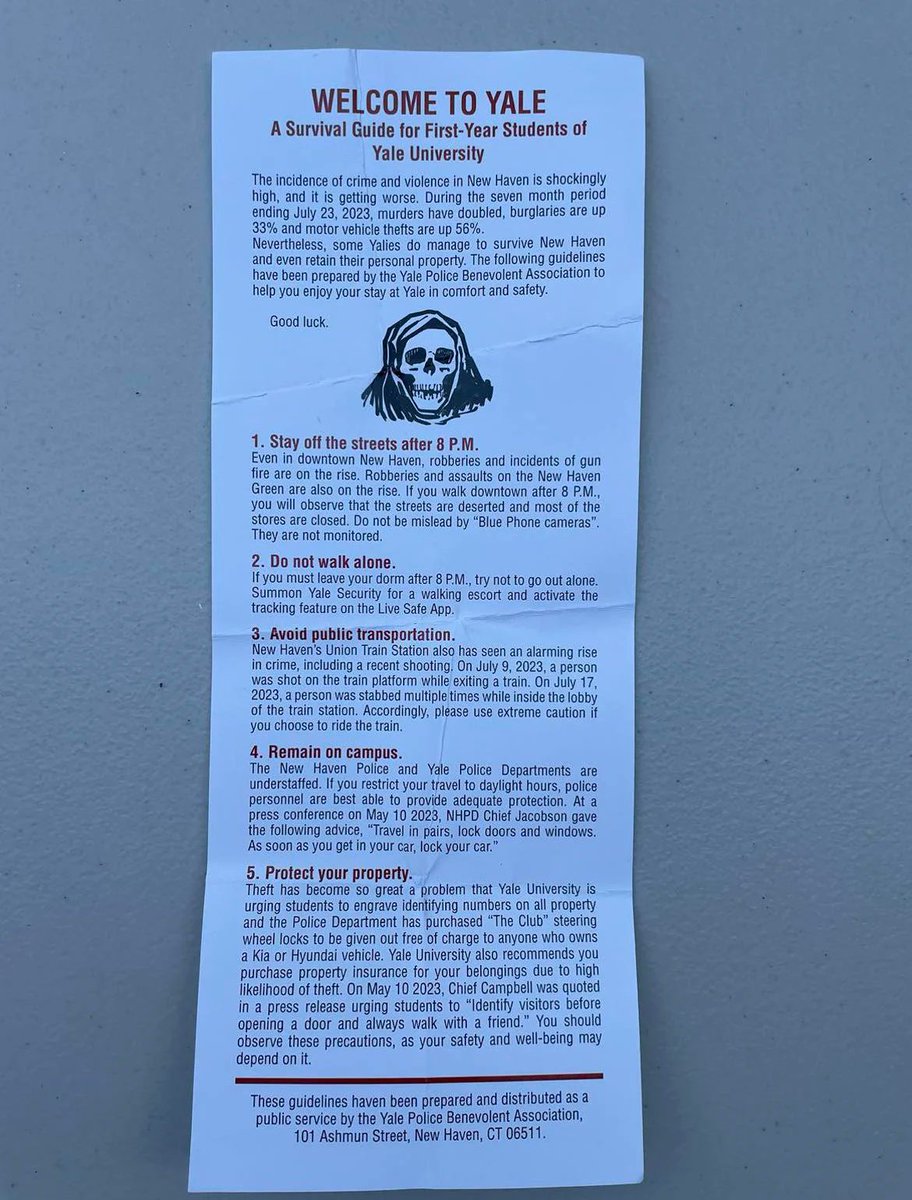
cab67
(3,762 posts)It's not a whole lot different from taking a job in a high-crime area.
That being said, this wasn't distributed by Yale University. It was distributed by the Yale Police Benevolent Association, whose viewpoint on things might be a bit slanted.
ripcord
(5,553 posts)I noticed it is still just as hard for younger students to make 8am classes, which I enjoyed. My business law class had a requirement for lots of classroom participation but since none of the other students were fully awake it turned into my professor and I discussing and arguing about the material, btw I enjoyed this class more than any other. There was also a good bit of discussion about giving them leeway because the online classes were harder to follow, I actually found them easier, probably because I am bad at taking notes. My professors had me helping some of these students, which was fine because it imprinted the material on me even further, but many times they would have an excuse as to why they couldn't make the tutoring session. It might be because I am older and more used to organizing my time but I didn't how they could always be behind, it could also have been that I was attending because I wanted to and had no pressure as to grades although I did finish with a 3.58 gpa.
cab67
(3,762 posts)Moreover, what you describe mirrors the experiences of many of us during the pandemic. The first pandemic generation (Fall 2021) was less prepared than its predecessors, and last year's wasn't much better. They'd finished high school with less rigorous schedules, and they arrived expecting that online instruction at a university would be just like online instruction in high school - which it generally wasn't.
This wasn't the fault of the students. Their educational background wasn't the same as before the pandemic, and it was completely beyond their control. It was also largely out of the control of teachers who worked their collective asses off to do the best they could with what most of us consider to be substandard instructional situations. We couldn't just assume the new crop of first-years was just lazy.
We knew this was coming, so a lot of us adjusted both our expectations and our instructional techniques. Note-taking skills had nosedived, and first- and second-year students were more likely to ask for scheduling accommodations that we were reluctant to grant. (Students who make informal section shifts, for example, are setting themselves up for having homework assignments or exams misplaced.)
Things seem to be improving. I'm teaching my first class of the semester in about an hour, so I might end up completely reversing that view once I'm done. (Hope not.)
Ms. Toad
(38,643 posts)I've been a night person my entire life. I've been forced to function much of my life on a morning schedule, since there is a strong bias towards morning people.
I'm nearly 67, retired, and my body clock wakes me up reliably between 11 and 12 every day. (I go to bed between 2 and 4.). I'm much happier on that schedule. That said, until just a few minutes ago, I would have been up and in class by 7:30 am 3 days a week for the coming semester. Not loving it, but I would have been awake, and functional . . . Unlike most morning people who couldn't function on my schedule if they tried.
ExWhoDoesntCare
(4,741 posts)If you're not a morning person, then college is your dream life. For most classes, you don't need to be there at the crack of dawn. You can schedule your course load for what suits your lifestyle, rather than the school's
I know I'm not a morning person. Never have been. That's why the only reason I'd even look at the campus at 8 am was if that were the only time available for a particular class I absolutely needed. Or a particular professor I wanted for a course important to my major.
Otherwise, see ya at 10.